The Interplay of Lifestyle and Oxidative Stress in Age-Related Hearing Loss

|
Lance Nelson, AuD, CCC-A
|
16/10/2023
The Interplay of Lifestyle and Oxidative Stress in Age-Related Hearing Loss
When you, or someone close to you, reach the age of 60 and begin to experience a subtle decline in hearing, you might wonder why.
You're not alone. An overwhelming 65 percent of adults aged 60 and over face age-related hearing loss, a condition deeply rooted in the very nature of aging and exacerbated by certain lifestyle choices.
Age-related hearing loss (ARHL) has far-reaching consequences, from affecting physical and mental well-being to limiting communication and resulting in poorer quality of life.
While hearing aids and interventions can bring relief, they can't completely restore the original state of hearing or stop the inexorable march of age-related hearing loss.
But what if certain elements of your lifestyle could play a part in preventing, or at least slowing down, this decline?
Understanding Oxidative Stress and ARHL
At its core, ARHL isn’t just about the passage of time; it’s deeply intertwined with the biological phenomena of oxidative stress and inflammation. For those unfamiliar with the term, oxidative stress occurs when there’s an imbalance between free radicals and antioxidants in the body.
Over time, when the scales tip in favor of free radicals, cells can get damaged.
Imagine these free radicals as tiny rebels inside your body, wreaking havoc. As we age, we naturally enter a state of chronic oxidative stress and inflammation.
Add to this a few lifestyle missteps, and you’re inadvertently amplifying the rebellion, leading to potential damage in the auditory nerve and inner ear.
How Lifestyle Factors Play Their Part
What’s empowering, however, is realizing that many risk factors for ARHLare within our control:
We live in a loud world. Constant exposure to noise, especially at higher decibels, can potentially damage the sensitive structures of the inner ear. Additionally, certain chemicals can be toxic to the hearing system and aggravate the oxidative balance.
It's no surprise that smoking has a long list of health hazards. Regarding hearing health, tobacco smoke, with its myriad toxins, can cause oxidative stress and contribute to age-related hearing loss.
You are what you eat. A poor diet, lacking in essential nutrients, can deprive the body of antioxidants, making it vulnerable to oxidative stress and inflammation.
Regular exercise helps enhance blood flow to the ear's sensitive structures and can fight off the harmful effects of oxidative stress. On the other hand, staying inactive could make one more susceptible to hearing loss.
Conditions like obesity, diabetes, and cardiovascular problems can further amplify the pro-oxidant and pro-inflammatory processes, indirectly influencing your hearing challenge.
Navigating the Path Ahead
With an aging population, the number of people with ARHL is bound to rise. But knowledge is power. By understanding the role of oxidative stress and making proactive lifestyle changes, it's highly likely that you can craft a better auditory future for yourself and your loved ones. You might not halt hearing loss entirely, but you can certainly delay its progression and ensure a higher quality of life.
Remember, no matter how small, every action can make a difference. From turning down the volume on your devices, opting for a balanced diet, and integrating regular exercise into your routine to seeking timely medical advice for chronic conditions—your ears will thank you.
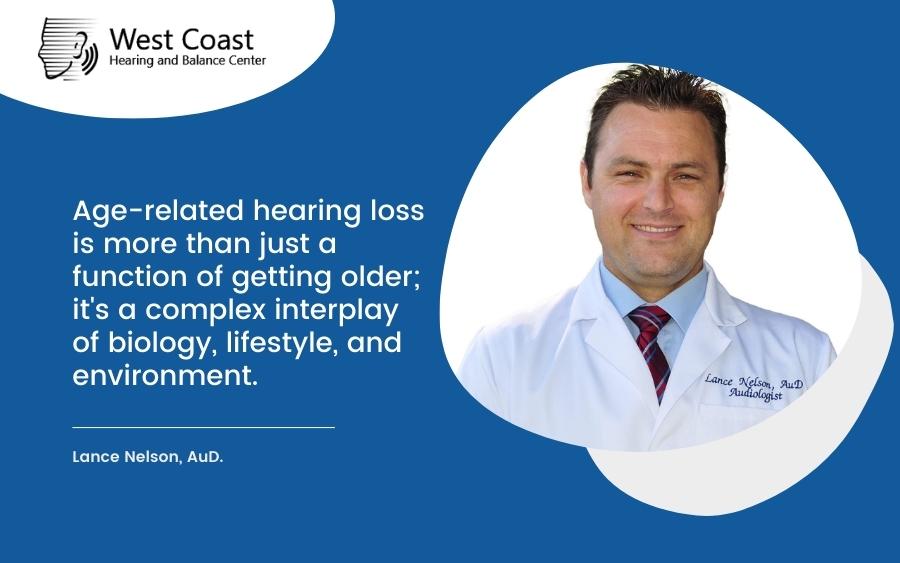
Age-related hearing loss is more than just a function of getting older; it's a complex interplay of biology, lifestyle, and environment. But in this dance, you have the power to lead.
If you’d like to learn more about this condition or get some answers on your hearing loss as you age, contact us or schedule your hearing assessment.
https://wchearing.com/wp-content/uploads/2023/10/Get-in-touch-today-to-schedule-your-hearing-assessment-1.jpg
Request a Callback
Search
|
Lance Nelson, AuD, CCC-A
|
16/10/2023
The Interplay of Lifestyle and Oxidative Stress in Age-Related Hearing Loss
When you, or someone close to you, reach the age of 60 and begin to experience a subtle decline in hearing, you might wonder why.
You're not alone. An overwhelming 65 percent of adults aged 60 and over face age-related hearing loss, a condition deeply rooted in the very nature of aging and exacerbated by certain lifestyle choices.
Age-related hearing loss (ARHL) has far-reaching consequences, from affecting physical and mental well-being to limiting communication and resulting in poorer quality of life.
While hearing aids and interventions can bring relief, they can't completely restore the original state of hearing or stop the inexorable march of age-related hearing loss.
But what if certain elements of your lifestyle could play a part in preventing, or at least slowing down, this decline?
Understanding Oxidative Stress and ARHL
At its core, ARHL isn’t just about the passage of time; it’s deeply intertwined with the biological phenomena of oxidative stress and inflammation. For those unfamiliar with the term, oxidative stress occurs when there’s an imbalance between free radicals and antioxidants in the body.
Over time, when the scales tip in favor of free radicals, cells can get damaged.
Imagine these free radicals as tiny rebels inside your body, wreaking havoc. As we age, we naturally enter a state of chronic oxidative stress and inflammation.
Add to this a few lifestyle missteps, and you’re inadvertently amplifying the rebellion, leading to potential damage in the auditory nerve and inner ear.
How Lifestyle Factors Play Their Part
What’s empowering, however, is realizing that many risk factors for ARHLare within our control:
We live in a loud world. Constant exposure to noise, especially at higher decibels, can potentially damage the sensitive structures of the inner ear. Additionally, certain chemicals can be toxic to the hearing system and aggravate the oxidative balance.
It's no surprise that smoking has a long list of health hazards. Regarding hearing health, tobacco smoke, with its myriad toxins, can cause oxidative stress and contribute to age-related hearing loss.
You are what you eat. A poor diet, lacking in essential nutrients, can deprive the body of antioxidants, making it vulnerable to oxidative stress and inflammation.
Regular exercise helps enhance blood flow to the ear's sensitive structures and can fight off the harmful effects of oxidative stress. On the other hand, staying inactive could make one more susceptible to hearing loss.
Conditions like obesity, diabetes, and cardiovascular problems can further amplify the pro-oxidant and pro-inflammatory processes, indirectly influencing your hearing challenge.
Navigating the Path Ahead
With an aging population, the number of people with ARHL is bound to rise. But knowledge is power. By understanding the role of oxidative stress and making proactive lifestyle changes, it's highly likely that you can craft a better auditory future for yourself and your loved ones. You might not halt hearing loss entirely, but you can certainly delay its progression and ensure a higher quality of life.
Remember, no matter how small, every action can make a difference. From turning down the volume on your devices, opting for a balanced diet, and integrating regular exercise into your routine to seeking timely medical advice for chronic conditions—your ears will thank you.
Age-related hearing loss is more than just a function of getting older; it's a complex interplay of biology, lifestyle, and environment. But in this dance, you have the power to lead.
If you’d like to learn more about this condition or get some answers on your hearing loss as you age, contact us or schedule your hearing assessment.
https://wchearing.com/wp-content/uploads/2023/10/Get-in-touch-today-to-schedule-your-hearing-assessment-1.jpg
Request a Callback
Search
|
Lance Nelson, AuD, CCC-A
|
16/10/2023
The Interplay of Lifestyle and Oxidative Stress in Age-Related Hearing Loss
When you, or someone close to you, reach the age of 60 and begin to experience a subtle decline in hearing, you might wonder why.
You're not alone. An overwhelming 65 percent of adults aged 60 and over face age-related hearing loss, a condition deeply rooted in the very nature of aging and exacerbated by certain lifestyle choices.
Age-related hearing loss (ARHL) has far-reaching consequences, from affecting physical and mental well-being to limiting communication and resulting in poorer quality of life.
While hearing aids and interventions can bring relief, they can't completely restore the original state of hearing or stop the inexorable march of age-related hearing loss.
But what if certain elements of your lifestyle could play a part in preventing, or at least slowing down, this decline?
Understanding Oxidative Stress and ARHL
At its core, ARHL isn’t just about the passage of time; it’s deeply intertwined with the biological phenomena of oxidative stress and inflammation. For those unfamiliar with the term, oxidative stress occurs when there’s an imbalance between free radicals and antioxidants in the body.
Over time, when the scales tip in favor of free radicals, cells can get damaged.
Imagine these free radicals as tiny rebels inside your body, wreaking havoc. As we age, we naturally enter a state of chronic oxidative stress and inflammation.
Add to this a few lifestyle missteps, and you’re inadvertently amplifying the rebellion, leading to potential damage in the auditory nerve and inner ear.
How Lifestyle Factors Play Their Part
What’s empowering, however, is realizing that many risk factors for ARHLare within our control:
We live in a loud world. Constant exposure to noise, especially at higher decibels, can potentially damage the sensitive structures of the inner ear. Additionally, certain chemicals can be toxic to the hearing system and aggravate the oxidative balance.
It's no surprise that smoking has a long list of health hazards. Regarding hearing health, tobacco smoke, with its myriad toxins, can cause oxidative stress and contribute to age-related hearing loss.
You are what you eat. A poor diet, lacking in essential nutrients, can deprive the body of antioxidants, making it vulnerable to oxidative stress and inflammation.
Regular exercise helps enhance blood flow to the ear's sensitive structures and can fight off the harmful effects of oxidative stress. On the other hand, staying inactive could make one more susceptible to hearing loss.
Conditions like obesity, diabetes, and cardiovascular problems can further amplify the pro-oxidant and pro-inflammatory processes, indirectly influencing your hearing challenge.
Navigating the Path Ahead
With an aging population, the number of people with ARHL is bound to rise. But knowledge is power. By understanding the role of oxidative stress and making proactive lifestyle changes, it's highly likely that you can craft a better auditory future for yourself and your loved ones. You might not halt hearing loss entirely, but you can certainly delay its progression and ensure a higher quality of life.
Remember, no matter how small, every action can make a difference. From turning down the volume on your devices, opting for a balanced diet, and integrating regular exercise into your routine to seeking timely medical advice for chronic conditions—your ears will thank you.
Age-related hearing loss is more than just a function of getting older; it's a complex interplay of biology, lifestyle, and environment. But in this dance, you have the power to lead.
If you’d like to learn more about this condition or get some answers on your hearing loss as you age, contact us or schedule your hearing assessment.
https://wchearing.com/wp-content/uploads/2023/10/Get-in-touch-today-to-schedule-your-hearing-assessment-1.jpg
Request a Callback
Search
Request a Callback
If you have a question or concern, simply complete this form and our staff will call you back for a friendly and helpful no-obligation conversation.
Don't want to wait? Then why not contact us today.

Request a Callback
If you have a question or concern, simply complete this form and our staff will call you back for a friendly and helpful no-obligation conversation.
Don't want to wait? Then why not contact us today.
Request a Callback
If you have a question or concern, simply complete this form and our staff will call you back for a friendly and helpful no-obligation conversation.
Don't want to wait? Then why not contact us today.