The Quiet Fade: Why We Stop Hearing the World (and How to Get it Back)

|
Hang Lam, AuD.
|
31/03/2026
The Quiet Fade: Why We Stop Hearing the World (and How to Get it Back)
I recently had the chance to share my story with Voyage LA, and the experience made me reflect on a moment that forever changed the way I think about hearing loss not just for me or my family, but for countless people across the greater Los Angeles area.
Years ago, my older sister was in nursing school, working hard to master her clinical skills. One day, she came home in tears, convinced she was failing as a student. She couldn’t hear her patient’s heartbeat through her stethoscope.
She thought she lacked the skill, but the truth was far more profound: she was living with high-frequency hearing loss.
That revelation transformed everything. It wasn’t about not trying hard enough or not being smart enough. It was about missing a vital piece of information, one that made all the difference in her career and her confidence.
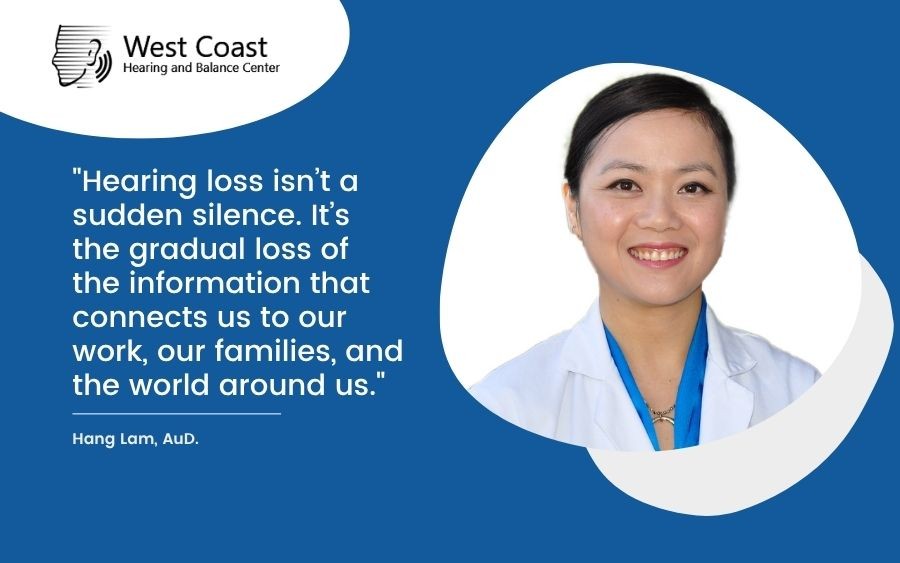
Hearing loss isn’t a sudden silence. It’s the gradual loss of the information that connects us to our work, our families, and the world around us.
The Invisible Decline: Why We Don't Notice Hearing Challenges
Hearing loss rarely announces itself; instead, it slips away in small, almost imperceptible increments. Most people don’t wake up one day unable to hear, but rather the world grows quieter, bit by bit.
This slow fade means that people often don’t notice the problem right away. Instead, they adapt. Maybe the TV volume creeps up over the months. Maybe you find yourself watching people’s lips more closely or nodding along in conversations even when you didn’t quite catch the punchline.
These subtle compensations become second nature, but all this adapting comes at a cost.
The brain works overtime to fill in the gaps, piecing together context clues and guessing at missed words. Over time, this mental juggling act leads to fatigue, leaving you exhausted after social gatherings or even just a day at work.
Many people chalk it up to aging or stress, never realizing how much effort their brain is putting into simply keeping up.
What You’re Missing (The Lifestyle Impact)
When hearing loss is gradual, you may not realize just how much you’re missing. Patients often tell me about the “forgotten sounds” they rediscover after prioritizing their hearing health:
The gentle chirping of birds outside their window in the morning.
The reassuring “clicks” of a car’s turn signal.
The delicate voices of grandchildren telling secrets or sharing laughter.
These small joys, once lost, can leave life feeling a little less vibrant.
But the impact goes beyond missed sounds. Social situations become challenging. The background noise at a restaurant, the overlapping conversations at a family dinner, or the echoes in a gym during a pickleball game… all can make it nearly impossible to keep up.
Many people start to withdraw, skipping dinners, parties, or favorite hobbies because it’s simply too overwhelming or embarrassing to ask others to repeat themselves.
This isolation can lead to loneliness, anxiety, and even depression. The world gets quieter, not just in sound but in connection.
Technology as a Bridge, not a Crutch
For many, the idea of hearing aids conjures images of bulky, whistling devices tucked behind the ear. But today’s technology is a world apart from those outdated stereotypes.
Modern hearing aids are sleek, discreet, and powered by sophisticated AI that can distinguish voices from background noise and adapt to different environments automatically.
The real magic, however, happens in the fitting process. At West Coast Hearing and Balance Center, we use real ear measurements and advanced fitting techniques to ensure each device is tailored to your unique hearing profile.
This isn’t about amplifying everything around you; it’s about mimicking natural hearing as closely as possible so the world sounds balanced and clear.
One of my favorite moments is seeing the expression on a patient’s face when they hear something they hadn’t realized was missing: the soft hum of the air conditioner, the rustle of leaves, or even their own footsteps on the floor.
That “Aha!” moment is a restoration of connection, confidence, and independence.
My sister’s story is a prime example: while she could hear me and our family talking to her, quieter, more subtle sounds like her patient’s heartbeat were nearly entirely lost until I helped her find an amplified stethoscope to help her hear the sounds she needed at work.
When I joined the West Coast team, my sister was my first patient. Hearing challenges are very personal, and it took me some time to find the best hearing solution for her needs, but a large part of my work here is helping patients like her reconnect with the moments in life that matter most.
Reclaiming Your Life with Expert Hearing Care
If a specialized stethoscope could save my sister’s nursing career, imagine what the right hearing solution could do for your daily life.
Better hearing isn’t just about more volume but about safety, confidence, and staying present in your own life. It’s about being able to laugh at a joke, catch the subtle cues in a conversation, and feel truly included.
If you’ve been toughing it out, telling yourself that “it’s not that bad” or that you can get by, I encourage you to reconsider. Hearing loss doesn’t have to mean giving up the things you love or the connections that matter most.
Don’t let the quiet fade steal your world. Take the first step toward getting it back by getting in touch with our expert team today!
Source
Voyage LA: Read Dr. Lam’s entire interview here!
Request a Callback
Search
|
Hang Lam, AuD.
|
31/03/2026
The Quiet Fade: Why We Stop Hearing the World (and How to Get it Back)
I recently had the chance to share my story with Voyage LA, and the experience made me reflect on a moment that forever changed the way I think about hearing loss not just for me or my family, but for countless people across the greater Los Angeles area.
Years ago, my older sister was in nursing school, working hard to master her clinical skills. One day, she came home in tears, convinced she was failing as a student. She couldn’t hear her patient’s heartbeat through her stethoscope.
She thought she lacked the skill, but the truth was far more profound: she was living with high-frequency hearing loss.
That revelation transformed everything. It wasn’t about not trying hard enough or not being smart enough. It was about missing a vital piece of information, one that made all the difference in her career and her confidence.
Hearing loss isn’t a sudden silence. It’s the gradual loss of the information that connects us to our work, our families, and the world around us.
The Invisible Decline: Why We Don't Notice Hearing Challenges
Hearing loss rarely announces itself; instead, it slips away in small, almost imperceptible increments. Most people don’t wake up one day unable to hear, but rather the world grows quieter, bit by bit.
This slow fade means that people often don’t notice the problem right away. Instead, they adapt. Maybe the TV volume creeps up over the months. Maybe you find yourself watching people’s lips more closely or nodding along in conversations even when you didn’t quite catch the punchline.
These subtle compensations become second nature, but all this adapting comes at a cost.
The brain works overtime to fill in the gaps, piecing together context clues and guessing at missed words. Over time, this mental juggling act leads to fatigue, leaving you exhausted after social gatherings or even just a day at work.
Many people chalk it up to aging or stress, never realizing how much effort their brain is putting into simply keeping up.
What You’re Missing (The Lifestyle Impact)
When hearing loss is gradual, you may not realize just how much you’re missing. Patients often tell me about the “forgotten sounds” they rediscover after prioritizing their hearing health:
The gentle chirping of birds outside their window in the morning.
The reassuring “clicks” of a car’s turn signal.
The delicate voices of grandchildren telling secrets or sharing laughter.
These small joys, once lost, can leave life feeling a little less vibrant.
But the impact goes beyond missed sounds. Social situations become challenging. The background noise at a restaurant, the overlapping conversations at a family dinner, or the echoes in a gym during a pickleball game… all can make it nearly impossible to keep up.
Many people start to withdraw, skipping dinners, parties, or favorite hobbies because it’s simply too overwhelming or embarrassing to ask others to repeat themselves.
This isolation can lead to loneliness, anxiety, and even depression. The world gets quieter, not just in sound but in connection.
Technology as a Bridge, not a Crutch
For many, the idea of hearing aids conjures images of bulky, whistling devices tucked behind the ear. But today’s technology is a world apart from those outdated stereotypes.
Modern hearing aids are sleek, discreet, and powered by sophisticated AI that can distinguish voices from background noise and adapt to different environments automatically.
The real magic, however, happens in the fitting process. At West Coast Hearing and Balance Center, we use real ear measurements and advanced fitting techniques to ensure each device is tailored to your unique hearing profile.
This isn’t about amplifying everything around you; it’s about mimicking natural hearing as closely as possible so the world sounds balanced and clear.
One of my favorite moments is seeing the expression on a patient’s face when they hear something they hadn’t realized was missing: the soft hum of the air conditioner, the rustle of leaves, or even their own footsteps on the floor.
That “Aha!” moment is a restoration of connection, confidence, and independence.
My sister’s story is a prime example: while she could hear me and our family talking to her, quieter, more subtle sounds like her patient’s heartbeat were nearly entirely lost until I helped her find an amplified stethoscope to help her hear the sounds she needed at work.
When I joined the West Coast team, my sister was my first patient. Hearing challenges are very personal, and it took me some time to find the best hearing solution for her needs, but a large part of my work here is helping patients like her reconnect with the moments in life that matter most.
Reclaiming Your Life with Expert Hearing Care
If a specialized stethoscope could save my sister’s nursing career, imagine what the right hearing solution could do for your daily life.
Better hearing isn’t just about more volume but about safety, confidence, and staying present in your own life. It’s about being able to laugh at a joke, catch the subtle cues in a conversation, and feel truly included.
If you’ve been toughing it out, telling yourself that “it’s not that bad” or that you can get by, I encourage you to reconsider. Hearing loss doesn’t have to mean giving up the things you love or the connections that matter most.
Don’t let the quiet fade steal your world. Take the first step toward getting it back by getting in touch with our expert team today!
Source
Voyage LA: Read Dr. Lam’s entire interview here!
Request a Callback
Search
|
Hang Lam, AuD.
|
31/03/2026
The Quiet Fade: Why We Stop Hearing the World (and How to Get it Back)
I recently had the chance to share my story with Voyage LA, and the experience made me reflect on a moment that forever changed the way I think about hearing loss not just for me or my family, but for countless people across the greater Los Angeles area.
Years ago, my older sister was in nursing school, working hard to master her clinical skills. One day, she came home in tears, convinced she was failing as a student. She couldn’t hear her patient’s heartbeat through her stethoscope.
She thought she lacked the skill, but the truth was far more profound: she was living with high-frequency hearing loss.
That revelation transformed everything. It wasn’t about not trying hard enough or not being smart enough. It was about missing a vital piece of information, one that made all the difference in her career and her confidence.
Hearing loss isn’t a sudden silence. It’s the gradual loss of the information that connects us to our work, our families, and the world around us.
The Invisible Decline: Why We Don't Notice Hearing Challenges
Hearing loss rarely announces itself; instead, it slips away in small, almost imperceptible increments. Most people don’t wake up one day unable to hear, but rather the world grows quieter, bit by bit.
This slow fade means that people often don’t notice the problem right away. Instead, they adapt. Maybe the TV volume creeps up over the months. Maybe you find yourself watching people’s lips more closely or nodding along in conversations even when you didn’t quite catch the punchline.
These subtle compensations become second nature, but all this adapting comes at a cost.
The brain works overtime to fill in the gaps, piecing together context clues and guessing at missed words. Over time, this mental juggling act leads to fatigue, leaving you exhausted after social gatherings or even just a day at work.
Many people chalk it up to aging or stress, never realizing how much effort their brain is putting into simply keeping up.
What You’re Missing (The Lifestyle Impact)
When hearing loss is gradual, you may not realize just how much you’re missing. Patients often tell me about the “forgotten sounds” they rediscover after prioritizing their hearing health:
The gentle chirping of birds outside their window in the morning.
The reassuring “clicks” of a car’s turn signal.
The delicate voices of grandchildren telling secrets or sharing laughter.
These small joys, once lost, can leave life feeling a little less vibrant.
But the impact goes beyond missed sounds. Social situations become challenging. The background noise at a restaurant, the overlapping conversations at a family dinner, or the echoes in a gym during a pickleball game… all can make it nearly impossible to keep up.
Many people start to withdraw, skipping dinners, parties, or favorite hobbies because it’s simply too overwhelming or embarrassing to ask others to repeat themselves.
This isolation can lead to loneliness, anxiety, and even depression. The world gets quieter, not just in sound but in connection.
Technology as a Bridge, not a Crutch
For many, the idea of hearing aids conjures images of bulky, whistling devices tucked behind the ear. But today’s technology is a world apart from those outdated stereotypes.
Modern hearing aids are sleek, discreet, and powered by sophisticated AI that can distinguish voices from background noise and adapt to different environments automatically.
The real magic, however, happens in the fitting process. At West Coast Hearing and Balance Center, we use real ear measurements and advanced fitting techniques to ensure each device is tailored to your unique hearing profile.
This isn’t about amplifying everything around you; it’s about mimicking natural hearing as closely as possible so the world sounds balanced and clear.
One of my favorite moments is seeing the expression on a patient’s face when they hear something they hadn’t realized was missing: the soft hum of the air conditioner, the rustle of leaves, or even their own footsteps on the floor.
That “Aha!” moment is a restoration of connection, confidence, and independence.
My sister’s story is a prime example: while she could hear me and our family talking to her, quieter, more subtle sounds like her patient’s heartbeat were nearly entirely lost until I helped her find an amplified stethoscope to help her hear the sounds she needed at work.
When I joined the West Coast team, my sister was my first patient. Hearing challenges are very personal, and it took me some time to find the best hearing solution for her needs, but a large part of my work here is helping patients like her reconnect with the moments in life that matter most.
Reclaiming Your Life with Expert Hearing Care
If a specialized stethoscope could save my sister’s nursing career, imagine what the right hearing solution could do for your daily life.
Better hearing isn’t just about more volume but about safety, confidence, and staying present in your own life. It’s about being able to laugh at a joke, catch the subtle cues in a conversation, and feel truly included.
If you’ve been toughing it out, telling yourself that “it’s not that bad” or that you can get by, I encourage you to reconsider. Hearing loss doesn’t have to mean giving up the things you love or the connections that matter most.
Don’t let the quiet fade steal your world. Take the first step toward getting it back by getting in touch with our expert team today!
Source
Voyage LA: Read Dr. Lam’s entire interview here!
Request a Callback
Search
Request a Callback
If you have a question or concern, simply complete this form and our staff will call you back for a friendly and helpful no-obligation conversation.
Don't want to wait? Then why not contact us today.

Request a Callback
If you have a question or concern, simply complete this form and our staff will call you back for a friendly and helpful no-obligation conversation.
Don't want to wait? Then why not contact us today.
Request a Callback
If you have a question or concern, simply complete this form and our staff will call you back for a friendly and helpful no-obligation conversation.
Don't want to wait? Then why not contact us today.